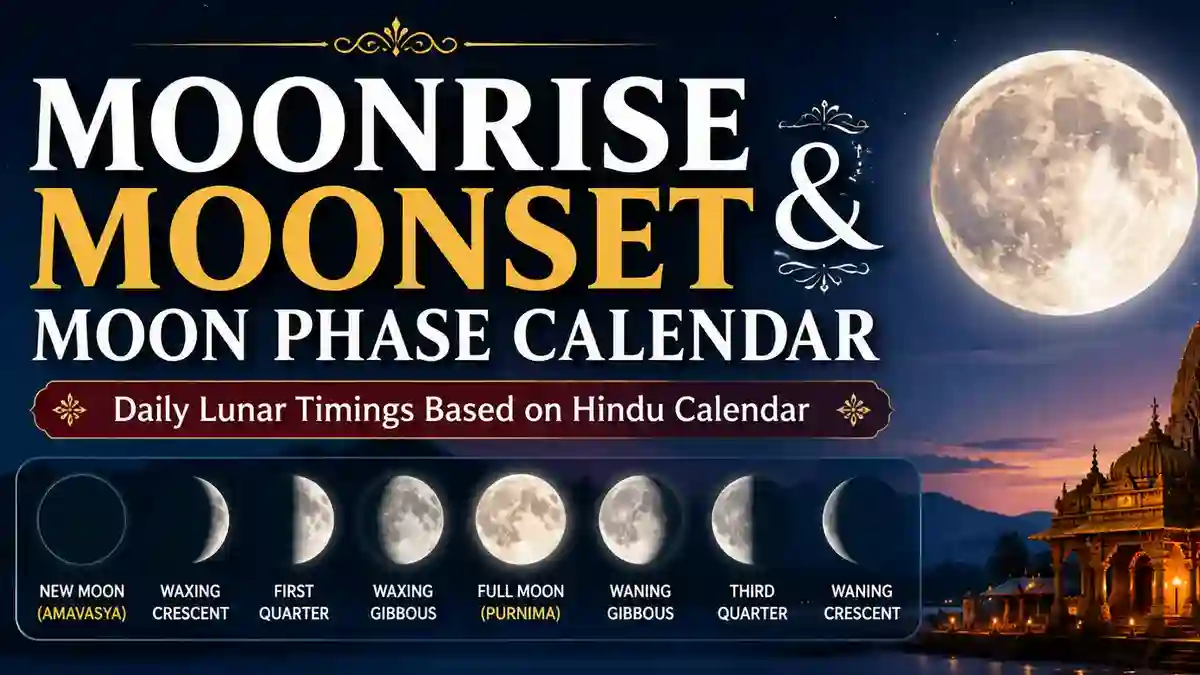
The Moon has a special place in Hinduism and is much more than a celestial body seen in the night sky. In the Hindu tradition, the Moon, known as Chandra or Soma, plays an important role in determining the Hindu calendar, calculating tithis, observing fasts, celebrating festivals, and performing religious rituals. Every day, the changing position of the Moon influences the Panchang, making moonrise and moonset timings valuable for devotees across India.
A Moonrise, Moonset and Moon Phase Time helps people understand when the Moon rises and sets, how its appearance changes throughout the month, and how these changes relate to Hindu festivals and daily worship. Whether you are observing a vrat, planning a religious ceremony, or simply interested in the lunar calendar, knowing the Moon’s daily movement can be helpful.
Moonrise, Moonset and Moon Phase Time Today
| Date | Moonrise | Moonset | Phase / Note | Distance (km) | Illumination |
| Jul 1 | 08:31 PM | 06:54 AM | Waning Gibbous | 404,082 | 99.3% |
| Jul 2 | 09:11 PM | 07:48 AM | Waning Gibbous | 402,038 | 96.8% |
| Jul 3 | 09:49 PM | 08:40 AM | Waning Gibbous | 399,367 | 92.4% |
| Jul 4 | 10:24 PM | 09:32 AM | Waning Gibbous | 396,071 | 86.2% |
| Jul 5 | 10:59 PM | 10:23 AM | Waning Gibbous | 392,158 | 78.4% |
| Jul 6 | 11:33 PM | 11:15 AM | Waning Gibbous | 387,663 | 69.1% |
| Jul 7 | — | 12:07 PM | Waning Gibbous | 382,684 | 58.7% |
| Jul 8 | 12:09 AM | 01:03 PM | Third Quarter (12:59 AM) | 377,400 | 47.6% |
| Jul 9 | 12:49 AM | 02:02 PM | Waning Crescent | 372,094 | 36.2% |
| Jul 10 | 01:34 AM | 05:06 PM | Waning Crescent | 367,149 | 25.2% |
| Jul 11 | 02:26 AM | 04:13 PM | Waning Crescent | 363,031 | 15.3% |
| Jul 12 | 03:25 AM | 05:22 PM | Waning Crescent | 360,218 | 7.4% |
| Jul 13 | 04:31 AM | 06:27 PM | Waning Crescent | 359,118 | 2.2% |
| Jul 14 | 05:41 AM | 07:27 PM | New Moon (03:13 PM) | 359,950 | 0.1% |
| Jul 15 | 06:50 AM | 08:18 PM | Waxing Crescent | 362,686 | 1.3% |
| Jul 16 | 07:55 AM | 09:04 PM | Waxing Crescent | 367,053 | 5.5% |
| Jul 17 | 08:56 AM | 09:44 PM | Waxing Crescent | 372,601 | 12.2% |
| Jul 18 | 09:53 AM | 10:21 PM | Waxing Crescent | 378,793 | 20.7% |
| Jul 19 | 10:46 AM | 10:56 PM | Waxing Crescent | 385,087 | 30.4% |
| Jul 20 | 11:38 AM | 11:31 PM | Waxing Crescent | 391,002 | 40.6% |
| Jul 21 | 12:30 PM | — | First Quarter | 396,154 | 50.9% |
| Jul 22 | 01:22 PM | 12:07 AM | Waxing Gibbous | 400,280 | 60.9% |
| Jul 23 | 02:15 PM | 12:46 AM | Waxing Gibbous | 403,233 | 70.3% |
| Jul 24 | 03:08 PM | 01:27 AM | Waxing Gibbous | 404,971 | 78.8% |
| Jul 25 | 04:02 PM | 02:13 AM | Waxing Gibbous | 405,548 | 86.2% |
| Jul 26 | 04:54 PM | 03:02 AM | Waxing Gibbous | 405,080 | 92.2% |
| Jul 27 | 05:43 PM | 03:54 AM | Waxing Gibbous | 403,731 | 96.7% |
| Jul 28 | 06:29 PM | 04:48 AM | Waxing Gibbous | — | — |
| Jul 29 | 07:11 PM | 05:42 AM | Waxing Gibbous | 401,676 | 99.3% |
| Jul 30 | 07:49 PM | 06:36 AM | Full Moon | 399,082 | 99.9% |
| Jul 31 | 08:26 PM | 07:28 AM | Waning Gibbous | 396,084 | 98.5% |
What Is Moonrise?
Moonrise is the moment when the Moon first appears above the eastern horizon. Unlike sunrise, which occurs at nearly the same time each day with gradual seasonal changes, moonrise shifts significantly from one day to the next because the Moon revolves around the Earth.
In Hindu traditions, moonrise is especially important for devotees observing fasts such as Karwa Chauth, Sankashti Chaturthi, Vinayaka Chaturthi, and other vratas where the fast is completed only after sighting the Moon.
What Is Moonset?
Moonset is the time when the Moon disappears below the western horizon. Moonset also changes daily because of the Moon’s orbit around the Earth. Together, moonrise and moonset help determine the Moon’s position in the sky throughout the day and night.
Many religious observances and Panchang calculations consider both moonrise and moonset while determining auspicious timings.
Why the Moon Is Important in Hinduism
The Moon is worshipped as Chandra Dev, one of the Navagrahas. Hindu scriptures describe Chandra as the deity associated with peace, emotions, beauty, calmness, and the mind. It is believed that the Moon influences human thoughts, emotions, and spiritual well-being.
The Moon is also closely connected with Lord Shiva. Many images of Lord Shiva show the crescent Moon adorning His head, symbolizing control over time and the mind. This connection gives the Moon additional religious significance for Shiva devotees.
Moon and the Hindu Calendar
Unlike the Gregorian calendar, the traditional Hindu calendar follows the lunar cycle. The phases of the Moon determine the beginning and end of each lunar month.
Every tithi is based on the angular distance between the Sun and the Moon rather than a fixed 24-hour day. Because of this, the Moon’s movement is essential for calculating:
- Tithi
- Paksha
- Purnima
- Amavasya
- Ekadashi
- Chaturthi
- Pradosh
- Festivals and vratas
Without the Moon’s changing position, the Hindu Panchang would not function as it does today.
Understanding Moon Phases
The Moon changes its appearance throughout the month because different portions of its sunlit surface become visible from Earth.
New Moon (Amavasya)
Amavasya occurs when the Moon is positioned between the Earth and the Sun, making it nearly invisible. This day holds spiritual importance for ancestor worship, charity, meditation, and many religious observances.
Waxing Moon
Following Amavasya, the illuminated portion of the Moon gradually increases. This period is known as Shukla Paksha and is generally considered favorable for new beginnings, worship, education, and auspicious ceremonies.
First Quarter
At this stage, approximately half of the Moon appears illuminated. It represents growth, progress, and the continuation of the lunar cycle.
Waxing Gibbous
The Moon continues becoming brighter each night until it reaches Full Moon.
Full Moon (Purnima)
Purnima is one of the most sacred days in Hinduism. Many important festivals fall on Full Moon, including Guru Purnima, Sharad Purnima, Holi, Buddha Purnima, Kartik Purnima, and several regional celebrations.
Many devotees perform Satyanarayan Puja, observe fasts, and participate in temple worship on Purnima.
Waning Moon
After the Full Moon, illumination gradually decreases during Krishna Paksha until the next Amavasya arrives, completing the lunar cycle.
Moonrise and Hindu Festivals
Several Hindu festivals depend directly on the Moon.
For Karwa Chauth, married women break their fast only after seeing the Moon. During Sankashti Chaturthi, devotees worship Lord Ganesha and end their fast after moonrise. Sharad Purnima is associated with the brightest Full Moon of the year and holds special spiritual significance. Guru Purnima, Hanuman Jayanti (in many traditions), and several regional festivals also follow lunar dates.
Because festival dates are based on tithis rather than fixed calendar dates, moonrise timings become especially important.
Why Moonrise and Moonset Times Change
Many people wonder why the Moon does not rise at the same time every day. This happens because the Moon revolves around the Earth while the Earth rotates on its axis. As a result, moonrise and moonset occur at different times each day.
The exact timing also varies depending on your location, longitude, latitude, elevation, and atmospheric conditions.
Benefits of a Moonrise and Moonset Time
A Moonrise and Moonset Time helps devotees and astronomy enthusiasts by providing daily information about the Moon’s movement.
It can be useful for:
- Observing Hindu fasts
- Following Panchang timings
- Planning religious ceremonies
- Night photography
- Stargazing
- Astronomy observations
- Educational purposes
- Understanding lunar phases
Moon Illumination
Moon illumination represents the percentage of the Moon’s visible surface illuminated by sunlight.
- Near 0% illumination, the Moon is close to Amavasya.
- Around 50%, it is near the First or Third Quarter.
- Close to 100%, the Moon appears as a Full Moon.
Tracking illumination helps explain why the Moon looks different every night.
Moon Distance from Earth
The Moon does not remain at a constant distance from Earth. It travels in an elliptical orbit, meaning its distance changes throughout the month. Sometimes the Moon appears slightly larger and brighter, while at other times it appears smaller. These natural variations are part of the Moon’s regular orbit.
How to Read a Moonrise and Moonset Time
A typical Moon calendar includes:
- Date
- Moonrise time
- Moonset time
- Moon phase
- Illumination percentage
- Moon distance
- Meridian passing time
Together, these details provide a complete picture of the Moon’s daily position and appearance.
Check Today’s Sunrise and Sunset Time
Along with moonrise and moonset, knowing the Sunrise and Sunset Time Today is equally important for daily Panchang calculations, Hindu rituals, fasting, and auspicious activities. Sunrise marks the beginning of the Hindu day, while sunset is used to determine the timing of many religious observances. You can also check our Sunrise and Sunset Time Today page for accurate daily timings and additional solar information.
Frequently Asked Questions
Moonrise determines the completion of several Hindu fasts and religious observances, including Karwa Chauth and Sankashti Chaturthi.
The Moon revolves around the Earth, causing moonrise and moonset to shift from day to day.
Purnima is considered highly auspicious for worship, fasting, charity, meditation, and many Hindu festivals.
Amavasya is associated with spiritual practices, remembrance of ancestors, and various religious rituals performed according to Hindu traditions.
