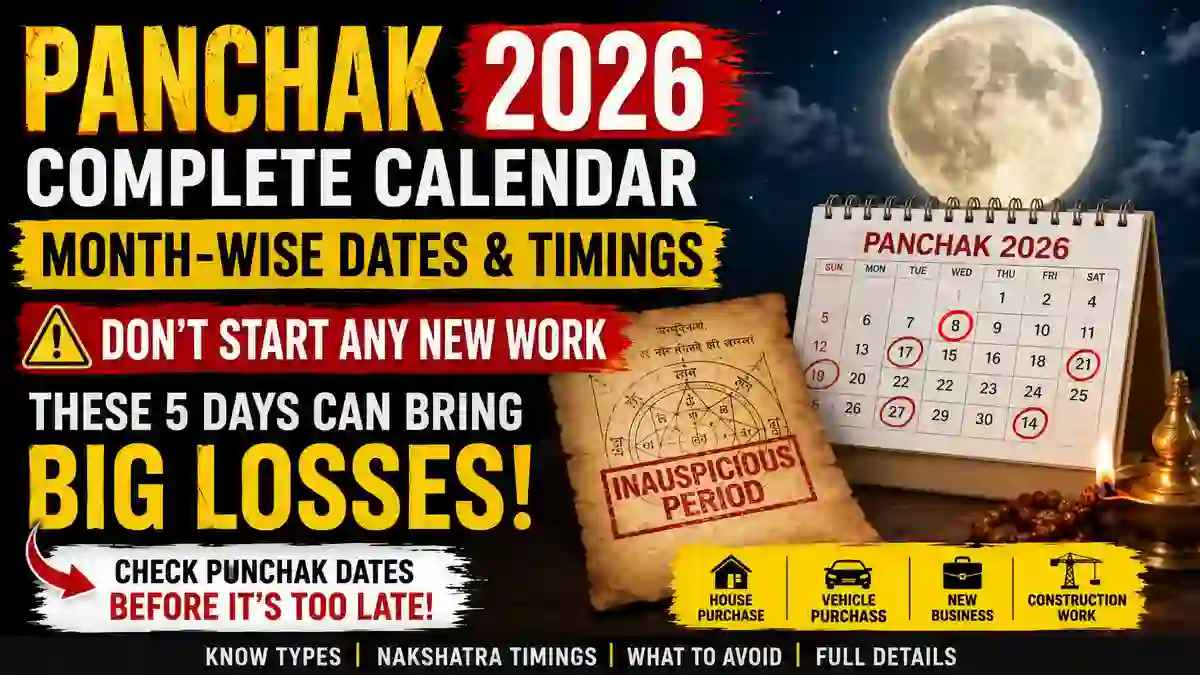
Panchak is considered an important period in the Hindu calendar and Vedic astrology. Many people check the Panchak today dates before starting a new business, purchasing a vehicle, performing housewarming ceremonies, or conducting other auspicious activities. According to traditional beliefs, Panchak is an inauspicious period when the Moon transits through the last five Nakshatras of the zodiac.
What is Panchak?
Panchak is a period of approximately five days that occurs when the Moon travels through the following five Nakshatras:
- Dhanishta (3rd and 4th Pada)
- Shatabhisha
- Purva Bhadrapada
- Uttara Bhadrapada
- Revati
These Nakshatras fall within the zodiac signs of Aquarius (Kumbha) and Pisces (Meena). According to Hindu beliefs, Panchak is generally considered an unfavorable time for beginning certain important activities.
However, many daily routines and essential tasks can still be performed. People mainly avoid major religious ceremonies and new beginnings during this period unless advised otherwise by a qualified priest or astrologer.
Panchak 2026 List Month-Wise Calendar
The table below provides the complete Panchak schedule for 2026.
| Month | Panchak Start | Panchak End | Panchak Type |
|---|---|---|---|
| January | 21 January 2026, Wednesday – 1:32 AM | 25 January 2026, Sunday – 1:35 PM | — |
| February | 17 February 2026, Tuesday – 9:01 AM | 21 February 2026, Saturday – 7:07 PM | Agni Panchak |
| March | 16 March 2026, Monday – 6:09 PM | 21 March 2026, Saturday – 2:27 AM | Rajya Panchak |
| April | 13 April 2026, Monday – 3:38 AM | 17 April 2026, Friday – 12:02 PM | Rajya Panchak |
| May | 10 May 2026, Sunday – 12:07 PM | 14 May 2026, Thursday – 10:33 PM | Rog Panchak |
| June | 6 June 2026, Saturday – 6:59 PM | 11 June 2026, Thursday – 8:16 AM | Mrityu Panchak |
| July | 4 July 2026, Saturday – 12:45 AM | 8 July 2026, Wednesday – 4:00 PM | Mrityu Panchak |
| July–August | 31 July 2026, Friday – 6:35 AM | 4 August 2026, Tuesday – 9:54 PM | Chor Panchak |
| August–September | 27 August 2026, Thursday – 1:31 PM | 1 September 2026, Tuesday – 3:23 AM | — |
| September | 23 September 2026, Wednesday – 9:52 PM | 28 September 2026, Monday – 10:16 AM | — |
| October | 21 October 2026, Wednesday – 6:55 AM | 25 October 2026, Sunday – 7:22 PM | — |
| November | 17 November 2026, Tuesday – 3:25 PM | 22 November 2026, Sunday – 5:54 AM | Agni Panchak |
| December | 14 December 2026, Monday – 10:32 PM | 19 December 2026, Saturday – 3:57 PM | Rajya Panchak |
Different Types of Panchak
Not every Panchak is the same. According to Hindu astrology, the day on which Panchak begins determines its type.
| Panchak Type | Starts On |
|---|---|
| Rog Panchak | Sunday |
| Rajya Panchak | Monday |
| Agni Panchak | Tuesday |
| Mrityu Panchak | Saturday |
| Chor Panchak | Friday |
Each type is traditionally associated with different beliefs and precautions. These classifications are based on astrological traditions followed in many parts of India.
Panchak July 2026
The first Panchak in July 2026 begins on 4 July and ends on 8 July. This Panchak is classified as Mrityu Panchak because it starts on a Saturday.
Panchak July 2026 Date
| Event | Date & Time |
|---|---|
| Panchak Starts | 4 July 2026, 12:45 AM |
| Panchak Ends | 8 July 2026, 4:00 PM |
| Panchak Type | Mrityu Panchak |
Panchak July 2026 Nakshatra Timings
| Nakshatra | Panchak Start | Panchak End |
|---|---|---|
| Dhanishta | 11:46 AM, 3 July (Fri) | 1:43 PM, 4 July (Sat) |
| Shatabhisha | 1:43 PM, 4 July (Sat) | 3:12 PM, 5 July (Sun) |
| Purva Bhadrapada | 3:12 PM, 5 July (Sun) | 4:07 PM, 6 July (Mon) |
| Uttara Bhadrapada | 4:07 PM, 6 July (Mon) | 4:24 PM, 7 July (Tue) |
| Revati | 4:24 PM, 7 July (Tue) | 4:00 PM, 8 July (Wed) |
Significance of Panchak in July 2026
The July Panchak falls during the holy month of Ashadha. Since it is a Mrityu Panchak, many followers of traditional astrology avoid beginning major life events, purchasing valuable assets, or performing important ceremonies during this period.
Those observing Panchak generally wait until the period ends before scheduling auspicious activities.
Panchak August 2026
August 2026 is unique because it contains two Panchak periods. The first begins at the end of July and continues into August, while the second starts later in August and concludes in early September.
First Panchak August 2026
| Event | Date & Time |
|---|---|
| Panchak Starts | 31 July 2026, 6:35 AM |
| Panchak Ends | 4 August 2026, 9:54 PM |
| Panchak Type | Chor Panchak |
Nakshatra Timings
| Nakshatra | Start | End |
|---|---|---|
| Dhanishta | 5:43 PM, 30 July (Thu) | 7:26 PM, 31 July (Fri) |
| Shatabhisha | 7:26 PM, 31 July (Fri) | 8:45 PM, 1 August (Sat) |
| Purva Bhadrapada | 8:45 PM, 1 August (Sat) | 9:37 PM, 2 August (Sun) |
| Uttara Bhadrapada | 9:37 PM, 2 August (Sun) | 10:00 PM, 3 August (Mon) |
| Revati | 10:00 PM, 3 August (Mon) | 9:54 PM, 4 August (Tue) |
Second Panchak August 2026
| Event | Date & Time |
|---|---|
| Panchak Starts | 27 August 2026, 1:31 PM |
| Panchak Ends | 1 September 2026, 3:23 AM |
Nakshatra Timings
| Nakshatra | Start | End |
|---|---|---|
| Dhanishta | 12:47 AM, 27 August (Thu) | 2:15 AM, 28 August (Fri) |
| Shatabhisha | 2:15 AM, 28 August (Fri) | 3:13 AM, 29 August (Sat) |
| Purva Bhadrapada | 3:13 AM, 29 August (Sat) | 3:42 AM, 30 August (Sun) |
| Uttara Bhadrapada | 3:42 AM, 30 August (Sun) | 3:44 AM, 31 August (Mon) |
| Revati | 3:44 AM, 31 August (Mon) | 3:23 AM, 1 September (Tue) |
Significance of Panchak in August 2026
Since August contains two Panchak periods, devotees planning weddings, housewarming ceremonies, or major purchases should carefully verify auspicious Muhurat dates before making important commitments.
Panchak September 2026
September also includes a Panchak that begins during the last week of the month.
Panchak September 2026 Date
| Event | Date & Time |
|---|---|
| Panchak Starts | 23 September 2026, 9:52 PM |
| Panchak Ends | 28 September 2026, 10:16 AM |
Panchak September 2026 Nakshatra Timings
| Nakshatra | Start | End |
|---|---|---|
| Dhanishta | 9:09 AM, 23 September (Wed) | 10:35 AM, 24 September (Thu) |
| Shatabhisha | 10:35 AM, 24 September (Thu) | 11:22 AM, 25 September (Fri) |
| Purva Bhadrapada | 11:22 AM, 25 September (Fri) | 11:32 AM, 26 September (Sat) |
| Uttara Bhadrapada | 11:32 AM, 26 September (Sat) | 11:08 AM, 27 September (Sun) |
| Revati | 11:08 AM, 27 September (Sun) | 10:16 AM, 28 September (Mon) |
Why People Observe Panchak
Many families consult the Panchang before fixing important dates. Although beliefs vary across regions and communities, Panchak continues to be an important consideration in Hindu traditions, particularly for religious ceremonies and significant life events.
Panchak October 2026
October Panchak begins in the third week of the month and continues for nearly five days as the Moon transits through the final five Nakshatras.
Panchak October 2026 Date
| Event | Date & Time |
|---|---|
| Panchak Starts | 21 October 2026, 6:55 AM |
| Panchak Ends | 25 October 2026, 7:22 PM |
Panchak October 2026 Nakshatra Timings
| Nakshatra | Start | End |
|---|---|---|
| Dhanishta | 6:02 PM, 20 October (Tue) | 7:47 PM, 21 October (Wed) |
| Shatabhisha | 7:47 PM, 21 October (Wed) | 8:49 PM, 22 October (Thu) |
| Purva Bhadrapada | 8:49 PM, 22 October (Thu) | 9:03 PM, 23 October (Fri) |
| Uttara Bhadrapada | 9:03 PM, 23 October (Fri) | 8:32 PM, 24 October (Sat) |
| Revati | 8:32 PM, 24 October (Sat) | 7:22 PM, 25 October (Sun) |
Significance of October Panchak
The October Panchak falls during the festive season in many parts of India. While people continue their daily routines, many families postpone major ceremonies such as housewarming, property registration, or the purchase of expensive items until Panchak concludes.
Panchak November 2026
The November Panchak is classified as Agni Panchak because it begins on a Tuesday. According to traditional beliefs, extra caution is advised regarding activities involving fire or major construction work during this period.
Panchak November 2026 Date
| Event | Date & Time |
|---|---|
| Panchak Starts | 17 November 2026, 3:25 PM |
| Panchak Ends | 22 November 2026, 5:54 AM |
| Panchak Type | Agni Panchak |
Panchak November 2026 Nakshatra Timings
| Nakshatra | Start | End |
|---|---|---|
| Dhanishta | 2:16 AM, 17 November (Tue) | 4:34 AM, 18 November (Wed) |
| Shatabhisha | 4:34 AM, 18 November (Wed) | 6:10 AM, 19 November (Thu) |
| Purva Bhadrapada | 6:10 AM, 19 November (Thu) | 6:56 AM, 20 November (Fri) |
| Uttara Bhadrapada | 6:56 AM, 20 November (Fri) | 6:50 AM, 21 November (Sat) |
| Revati | 6:50 AM, 21 November (Sat) | 5:54 AM, 22 November (Sun) |
Importance of November Panchak
Many devotees consult the Panchang before scheduling auspicious events during November because it often coincides with important religious observances. Those who follow traditional astrology generally choose Muhurat dates after Panchak ends.
Panchak December 2026
The final Panchak of 2026 occurs in December and is classified as Rajya Panchak.
Panchak December 2026 Date
| Event | Date & Time |
|---|---|
| Panchak Starts | 14 December 2026, 10:32 PM |
| Panchak Ends | 19 December 2026, 3:57 PM |
| Panchak Type | Rajya Panchak |
Panchak December 2026 Nakshatra Timings
| Nakshatra | Start | End |
|---|---|---|
| Dhanishta | 9:12 AM, 14 December (Mon) | 11:52 AM, 15 December (Tue) |
| Shatabhisha | 11:52 AM, 15 December (Tue) | 2:02 PM, 16 December (Wed) |
| Purva Bhadrapada | 2:02 PM, 16 December (Wed) | 3:30 PM, 17 December (Thu) |
| Uttara Bhadrapada | 3:30 PM, 17 December (Thu) | 4:10 PM, 18 December (Fri) |
| Revati | 4:10 PM, 18 December (Fri) | 3:57 PM, 19 December (Sat) |
Why December Panchak Matters
Since December is a popular month for weddings, property purchases, and new business planning, many families check Panchak dates before finalizing important events. Choosing an auspicious Muhurat after Panchak is a common practice in Hindu traditions.
You may also like our Moonrise, Moonset Time to understand lunar timings and our Hindu Festival Calendar 2026 for a complete list of upcoming festivals and auspicious dates.
Activities Traditionally Avoided During Panchak
According to Hindu beliefs, certain activities are often postponed during Panchak.
These commonly include:
- Housewarming ceremonies (Griha Pravesh)
- Beginning house construction
- Purchasing major property
- Buying expensive vehicles
- Starting a new business
- Performing certain religious rituals
- Making large financial investments without an auspicious Muhurat
These practices vary among families and regions. Many people consult a priest or astrologer before making important decisions.
Activities That Can Be Done During Panchak
Panchak does not stop everyday life. Most routine activities continue as usual.
People generally continue:
- Office work
- School and college activities
- Travel
- Shopping for daily needs
- Worship and regular prayers
- Medical treatment
- Routine business operations
Religious Significance of Panchak
In Vedic astrology, the Moon represents emotions, the mind, and daily experiences. During its transit through the final five Nakshatras—Dhanishta, Shatabhisha, Purva Bhadrapada, Uttara Bhadrapada, and Revati – the period is traditionally known as Panchak.
Many Hindu communities believe this phase carries unique astrological influences, making it preferable to postpone certain auspicious activities until the Moon moves into the next Nakshatra.
The Five Panchak Nakshatras
The Panchak period consists of these five Nakshatras:
| Nakshatra | Zodiac Sign |
|---|---|
| Dhanishta (3rd & 4th Pada) | Aquarius |
| Shatabhisha | Aquarius |
| Purva Bhadrapada | Aquarius–Pisces |
| Uttara Bhadrapada | Pisces |
| Revati | Pisces |
These five Nakshatras collectively form the Panchak period every lunar month.
Traditional Beliefs About Birth and Death During Panchak
Certain traditional beliefs associate Panchak with birth and death. Some communities perform specific rituals if a death occurs during Panchak, believing these rituals help remove unfavorable effects.
These customs vary across different regions of India and are based on local traditions rather than universally accepted religious rules.
Families usually seek guidance from knowledgeable priests before performing such rituals.
Does Everyone Need to Follow Panchak?
Not necessarily.
The observance of Panchak depends on:
- Family traditions
- Regional customs
- Religious beliefs
- Advice from priests or astrologers
Many people consider Panchak while planning important ceremonies, while others may not observe it at all.
Disclaimer: The Panchak dates, timings, and traditional beliefs presented in this article are based on the Hindu Panchang and commonly followed astrological practices. Customs and interpretations may differ by region, community, and family tradition. For important religious ceremonies or life events, consult a qualified priest or astrologer.
FAQ
Panchak is a period of about five days in the Hindu calendar when the Moon transits through the last five Nakshatras—Dhanishta (3rd and 4th Pada), Shatabhisha, Purva Bhadrapada, Uttara Bhadrapada, and Revati. According to traditional beliefs and Vedic astrology, it is considered an inauspicious time for certain important activities.
Panchak occurs several times during 2026. Some of the major Panchak periods include 4 July to 8 July, 31 July to 4 August, 27 August to 1 September, 23 September to 28 September, 21 October to 25 October, 17 November to 22 November, and 14 December to 19 December 2026. The exact timings depend on the Moon’s transit through the Panchak Nakshatras.
According to traditional Hindu beliefs, people often avoid starting a new business, performing Griha Pravesh (housewarming), purchasing property or vehicles, beginning house construction, and conducting certain auspicious ceremonies during Panchak. Everyday activities, work, travel, and regular worship can generally continue as usual.
The five types of Panchak are Rog Panchak, Rajya Panchak, Agni Panchak, Mrityu Panchak, and Chor Panchak. The type of Panchak is determined by the weekday on which it begins. Each type has its own traditional significance in Hindu astrology.
Not always. The importance of Panchak varies according to family traditions, regional customs, and personal beliefs. Many people consult a priest or astrologer before scheduling important events during Panchak, while others may not observe these traditions.
