Google Snippet (Quick Answer)
Solar New Year 2026 in India begins on April 14, 2026 (Tuesday) during Mesha Sankranti, when the Sun enters Aries. The exact Sankranti moment is 09:39 AM (IST). This day marks the start of the Hindu Solar Calendar and is celebrated across India as Puthandu, Vishu, Baisakhi, Bihu, and Pohela Boishakh. It is also linked to the concept of the Astronomical New Year 2026, based on solar transitions rather than lunar cycles.
What is Solar New Year 2026
The Solar New Year 2026 is a calendar-based new year determined by the movement of the Sun rather than the Moon. It begins when the Sun enters the Aries zodiac sign, also known as Mesha Rashi in Vedic astrology.
Unlike the Gregorian New Year on January 1, the solar new year follows astronomical calculations and is deeply rooted in traditional calendars used in India and other cultures.
The event is widely known as Mesha Sankranti in India and marks the beginning of a new solar cycle, making it significant for religious, cultural, and agricultural purposes.
Solar New Year 2026 Date and Time in India
The Solar New Year 2026 date and time are based on precise astronomical calculations. Below are the important details:
| Event | Date | Time |
|---|---|---|
| Solar New Year 2026 Date | April 14, 2026 | Tuesday |
| Sankranti Moment | April 14, 2026 | 09:39 AM |
| Punya Kala | 05:57 AM – 01:55 PM | |
| Maha Punya Kala | 07:30 AM – 11:47 AM |
This timing is calculated according to Indian Standard Time and may slightly vary based on location.
Solar New Year 2026 Calendar Across India
India follows multiple solar calendars, and the Solar New Year 2026 is celebrated differently across regions:
Regional Names and Celebrations
- Tamil Nadu: Puthandu
- Kerala: Vishu
- Punjab: Vaisakhi
- Assam: Bohag Bihu
- West Bengal: Pohela Boishakh
- Odisha: Pana Sankranti
Each region uses slightly different rules to determine the first day, but all are based on the Sun’s transition into Aries.
Solar New Year 2026 in India: Cultural Importance
The Solar New Year 2026 in India is not just a calendar event but a deeply spiritual occasion. People perform rituals, offer prayers, donate to charity, and celebrate with traditional foods.
Key Rituals
- Holy bath in rivers
- Charity and donations (Dan-Punya)
- Temple visits
- Preparation of festive meals
Agricultural Significance
This time also marks the harvest season in many parts of India, making it an important festival for farmers.
Solar New Year 2026 USA and Global Observance
The Solar New Year 2026 USA is not a public holiday but is observed by Indian communities and those following Vedic traditions.
Globally, solar new year systems are used in:
- Persian Nowruz (around March 21)
- Thai Songkran (April 13–15)
- Cambodian New Year
This shows that solar-based calendars are widely recognized across cultures.
Astronomical New Year 2026 Explained
The Astronomical New Year 2026 refers to the Sun’s movement into Aries, which is a key point in celestial calculations.
From an astronomical perspective:
- It marks the beginning of the zodiac cycle
- It is based on Earth’s orbit around the Sun
- It aligns closely with seasonal transitions
This makes it more scientifically grounded compared to purely lunar calendars.
Solar New Year 2026 Astrology Predictions
Solar New Year astrology provides insights into global and personal trends based on planetary positions.
Key Astrological Observations
- Sun enters Aries (Mesha Rashi)
- Associated Nakshatra: Shatabhisha
- Karana: Kaulava
General Predictions
- Economic fluctuations and rising commodity prices
- Possible health concerns like seasonal illnesses
- Increased geopolitical tensions
- Agricultural challenges due to irregular rainfall
These predictions are derived from traditional Panchang calculations.
Solar Eclipse 2026 Visible in India
Many people search for Solar eclipse 2026 visible in India along with solar new year.
In 2026, a solar eclipse will occur, but its visibility in India depends on geographic alignment. Most eclipses are either partial or not visible in India.
Eclipses are considered important in astrology but are separate events from the Solar New Year.
What is the Difference Between Lunar New Year and Solar New Year
Understanding the difference between Lunar New Year and solar new year is essential.
| Feature | Solar New Year | Lunar New Year |
|---|---|---|
| Based On | Sun’s position | Moon phases |
| Example | Mesha Sankranti | Chinese New Year |
| Calendar Type | Solar | Lunar or Lunisolar |
| Date Variation | Fixed (April 13–15) | Changes yearly |
Solar calendars are more aligned with seasons, while lunar calendars shift each year.
Is March 25th a Real New Year
The question “Is March 25th a real new year?” comes from historical traditions.
In some ancient European calendars:
- March 25 (Feast of Annunciation) was considered New Year’s Day
- It marked the beginning of spring
However, in modern systems, it is not widely recognized as the start of a new year.
Who Celebrates the Solar New Year
The Solar New Year 2026 is celebrated by millions worldwide.
Major Groups
- Hindus in India
- Sikhs (Vaisakhi)
- Buddhists in Southeast Asia
- Persian communities (Nowruz)
Each culture celebrates differently but shares the same solar transition principle.
Step-by-Step Guide to Celebrate Solar New Year 2026
Follow this structured guide for proper celebration:
Step 1: Wake Up Early
Start the day before sunrise and take a holy bath.
Step 2: Perform Puja
Offer prayers to the Sun God and seek blessings for prosperity.
Step 3: Observe Punya Kala
Perform charity and rituals during the auspicious time window.
Step 4: Prepare Traditional Food
Cook regional dishes and share with family.
Step 5: Visit Temple
Seek blessings and participate in community celebrations.
Solar New Year 2026 Calendar Summary Table
| Region | Festival Name | Date |
|---|---|---|
| Tamil Nadu | Puthandu | April 14, 2026 |
| Kerala | Vishu | April 14, 2026 |
| Punjab | Vaisakhi | April 14, 2026 |
| Assam | Bihu | April 14, 2026 |
| West Bengal | Pohela Boishakh | April 15, 2026 |
Importance of Mesha Sankranti 2026
Mesha Sankranti is the backbone of the Solar New Year 2026 calendar. It determines:
- Beginning of the Hindu solar year
- Timing of festivals
- Astrological predictions
It is also known as Maha Vishuva Sankranti and holds deep spiritual meaning.
For more helpful content and updates, follow us on Instagram and Quora.
Frequently Asked Questions
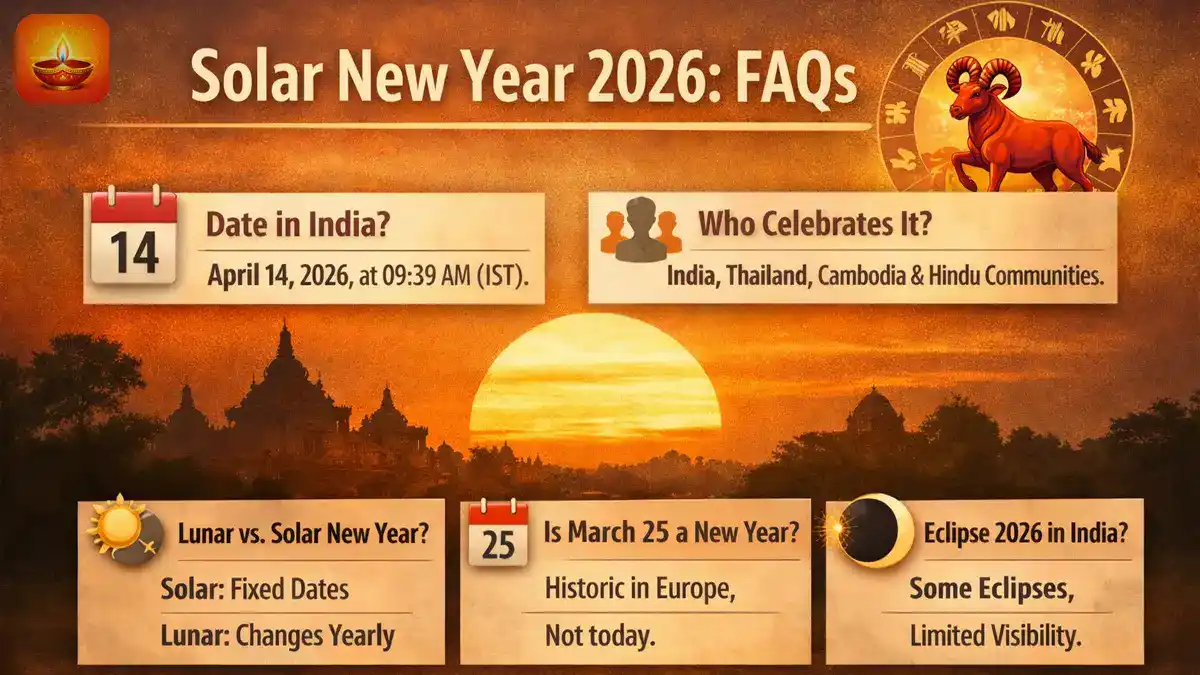
April 14, 2026, with Sankranti moment at 09:39 AM (IST).
People across India and countries like Thailand, Cambodia, and among global Hindu communities.
Solar is based on the Sun (fixed dates), lunar is based on the Moon (changes yearly).
Historically yes in some regions, but not in modern calendars.
Some eclipses occur, but most may not be clearly visible in India.