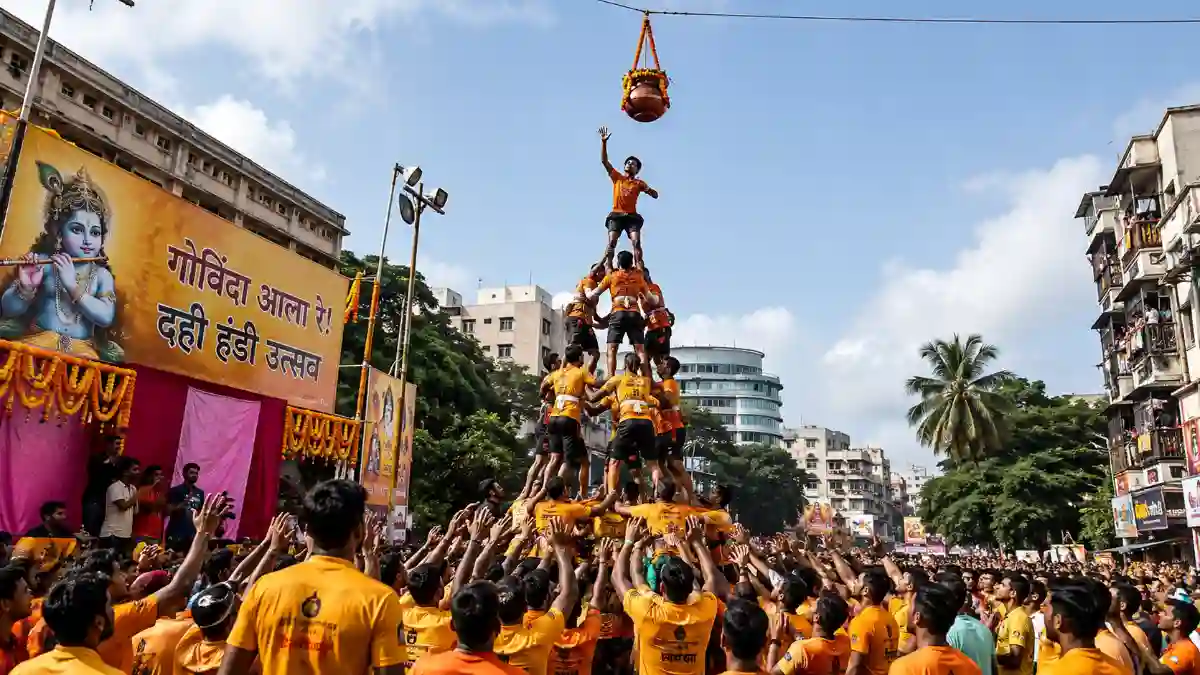
Gopalakala 2026 will be celebrated on Saturday, September 5, 2026, one day after Krishna Janmashtami. Gopalakala is closely associated with the Dahi Handi celebration, especially in Maharashtra and Goa, where devotees and Govinda teams recreate the playful childhood stories of Lord Krishna.
Krishna Janmashtami will be observed on Friday, September 4, 2026. The festival commemorates the birth of Lord Krishna, while Gopalakala and Dahi Handi celebrations traditionally take place on the following day.
For devotees in Maharashtra, Gopalakala is more than a festive gathering. It combines devotion, community participation, traditional food, music and the famous Dahi Handi ceremony inspired by the childhood stories of Krishna.
Gopalakala 2026 Date
The date of Gopalakala 2026 is Saturday, September 5, 2026.
| Festival | Date | Day |
|---|---|---|
| Krishna Janmashtami 2026 | September 4, 2026 | Friday |
| Gopalakala 2026 | September 5, 2026 | Saturday |
| Dahi Handi 2026 | September 5, 2026 | Saturday |
Gopalakala is generally celebrated on the day after Krishna Janmashtami. In Maharashtra, the day is strongly associated with Dahi Handi and Govinda celebrations.
Gopalakala 2026 Time and Tithi
The exact Panchang timings can vary according to location. For Pune, Maharashtra, the relevant Krishna Janmashtami Tithi timings are:
| Panchang Detail | Date and Time |
|---|---|
| Ashtami Tithi Begins | September 4, 2026 at 2:25 AM |
| Ashtami Tithi Ends | September 5, 2026 at 12:13 AM |
| Krishna Janmashtami | September 4, 2026 |
| Gopalakala / Dahi Handi | September 5, 2026 |
These timings are location-specific, so people observing religious rituals in other cities should refer to the Panchang for their own location.
What Is Gopalakala?
Gopalakala is a traditional celebration associated with Lord Krishna and his childhood as a cowherd, or Gopala. The name combines the idea of Gopala, a name associated with Krishna, with Kala, referring to a mixture or preparation of various ingredients.
In Maharashtra, Gopalakala is closely connected with Dahi Handi. The celebration remembers the playful nature of young Krishna, who was fond of butter, curd and other milk products.
The festival brings together religious devotion and community celebration. Groups of young people, traditionally known as Govindas, form human pyramids to reach and break a suspended earthen pot containing curd or other festive items.
Why Is Gopalakala Celebrated?
Gopalakala is celebrated to remember the childhood stories of Lord Krishna, particularly his love for butter and curd.
According to popular Krishna traditions, young Krishna and his friends would try to obtain butter and curd kept in pots that were deliberately placed out of reach. To make the pots difficult to reach, they were sometimes suspended high above the ground.
Krishna and his friends are traditionally said to have formed a human pyramid to reach these pots.
The modern Dahi Handi celebration draws inspiration from this popular story and turns it into a lively community event.
Gopalakala and Dahi Handi: Are They the Same?
Gopalakala and Dahi Handi are closely related but the names can refer to different aspects of the celebration.
Dahi Handi primarily refers to the event in which Govinda teams form human pyramids to break a suspended pot.
Gopalakala refers more broadly to the traditional celebration associated with Krishna’s childhood, including the preparation and sharing of a mixture made from different ingredients.
In Maharashtra, however, the two traditions are strongly connected and are commonly celebrated around the same time.
Significance of Gopalakala
Gopalakala has both religious and social significance.
1. Remembering Lord Krishna’s Childhood
The festival recalls Krishna’s playful childhood in Gokul and Vrindavan. Stories of Krishna stealing butter and sharing it with his friends are an important part of Krishna’s popular devotional tradition.
2. Symbol of Teamwork
The human pyramid represents cooperation. A Govinda team cannot reach the Handi successfully unless its members coordinate with one another.
3. Community Participation
Dahi Handi brings people together from different communities and age groups. Streets and neighbourhoods can become centres of celebration, with music, decorations and cultural activities.
4. Celebration of Devotion
The festival provides devotees with an opportunity to celebrate Krishna through music, devotional activities and traditional customs.
5. Sharing Food
Gopalakala also has an important food tradition. A mixture of different ingredients is prepared and shared among participants and devotees, reflecting the spirit of community and togetherness.
How Is Gopalakala Celebrated in Maharashtra?
Gopalakala celebrations are particularly popular in Maharashtra, with major festivities taking place in cities such as Mumbai, Thane, Pune and other parts of the state.
A typical celebration may include:
- Decorating the Dahi Handi
- Forming Govinda teams
- Building human pyramids
- Breaking the suspended Handi
- Playing devotional and traditional music
- Chanting slogans associated with Krishna
- Organizing cultural programmes
- Preparing and sharing Gopalakala
- Distributing prasad
- Participating in community celebrations
The atmosphere can become especially energetic when Govinda teams attempt to reach Handis placed several metres above the ground.
Dahi Handi 2026 in Maharashtra
Dahi Handi 2026 will be celebrated on Saturday, September 5, 2026, in Maharashtra.
The event is particularly famous in Mumbai, where Dahi Handi has developed into a large-scale public celebration. Govinda teams compete to break Handis suspended at significant heights, often in front of large crowds.
Over the years, Dahi Handi has evolved from a traditional religious celebration into a major cultural and competitive event in parts of Maharashtra.
The famous slogan “Govinda Aala Re!” is strongly associated with the festival and can be heard during celebrations.
Gopalakala 2026 Food Tradition
Food is an important part of Gopalakala.
The traditional preparation is generally made by mixing several ingredients together. Depending on local customs and family traditions, ingredients can include:
- Curd
- Milk
- Poha
- Cucumber
- Coconut
- Fruits
- Pomegranate
- Coriander
- Chilli
- Salt
- Other locally used ingredients
The exact recipe differs from one household or community to another.
The prepared Gopalakala is shared among devotees and participants as part of the celebration.
Gopalakala vs Krishna Janmashtami
Although both festivals are associated with Lord Krishna, they mark different parts of the celebration.
| Feature | Krishna Janmashtami | Gopalakala / Dahi Handi |
|---|---|---|
| Main significance | Birth of Lord Krishna | Celebration of Krishna’s childhood and playful traditions |
| 2026 Date | September 4 | September 5 |
| Main association | Krishna’s birth | Dahi Handi and Govinda celebrations |
| Popular customs | Fasting, midnight worship, Krishna puja | Human pyramids, breaking Handi, community celebrations |
| Maharashtra tradition | Gokulashtami / Janmashtami | Gopalakala and Dahi Handi |
Gopalakala 2026 in Pune
For devotees in Pune, Gopalakala and Dahi Handi will be celebrated on Saturday, September 5, 2026.
Pune follows the Maharashtra tradition of celebrating Dahi Handi on the day after Krishna Janmashtami. Local societies, temples and community groups may organize their own programmes.
Because religious timings can differ by location, devotees should use a Pune-specific Panchang when planning rituals that depend on Tithi or other astronomical timings.
Gopalakala 2026 in Mumbai
Mumbai is one of the most prominent centres for Dahi Handi celebrations in Maharashtra.
Large numbers of Govinda teams participate in public events, and major celebrations can attract significant crowds. Music, cultural programmes, decorated Handis and competitive pyramid formations are common features.
The festival has become an important part of Mumbai’s cultural identity during the Krishna Janmashtami season.
The Story Behind Dahi Handi
The tradition of Dahi Handi comes from popular stories about Krishna’s childhood.
Krishna was known for his fondness for butter and curd. In traditional stories, women in the village would keep dairy products in pots and place them higher up to prevent Krishna and his friends from taking them.
Rather than giving up, Krishna and his friends are said to have worked together to form a human pyramid and reach the pot.
The modern Dahi Handi tradition recreates this playful episode through organised community celebrations.
The story also carries a simple message: cooperation and collective effort can help overcome difficult challenges.
Importance of Teamwork in Dahi Handi
One of the most distinctive aspects of Dahi Handi is the human pyramid.
A Govinda team normally consists of multiple participants who work together to reach the Handi. Each person has a specific position and responsibility within the formation.
The celebration therefore highlights values such as:
- Teamwork
- Trust
- Coordination
- Discipline
- Courage
- Community spirit
Modern public events also place increasing importance on participant safety, particularly because the pyramid can involve multiple levels.
Gopalakala 2026 Celebration and Safety
Dahi Handi involves physical activity and can carry a risk of falls or injuries. Organizers and participants should follow applicable local safety requirements and use appropriate precautions.
Important measures can include:
- Proper supervision
- Trained participants
- Suitable protective arrangements
- Controlled crowd movement
- Medical assistance at large events
- Following local administration and event-organizer guidelines
- Avoiding unsafe heights or formations
The devotional and cultural spirit of Gopalakala should always be balanced with participant and public safety.
When Is Gopalakala 2026?
Gopalakala 2026 will be celebrated on Saturday, September 5, 2026.
It falls one day after Krishna Janmashtami 2026, which will be observed on Friday, September 4.
When Is Dahi Handi 2026?
Dahi Handi 2026 is on Saturday, September 5, 2026.
In Maharashtra, Dahi Handi is traditionally celebrated on the day following Krishna Janmashtami.
When Is Krishna Janmashtami 2026?
Krishna Janmashtami 2026 will be celebrated on Friday, September 4, 2026.
For Pune, the Ashtami Tithi begins at 2:25 AM on September 4 and ends at 12:13 AM on September 5.
The exact observance and puja timings may vary according to location and local Panchang calculations.
