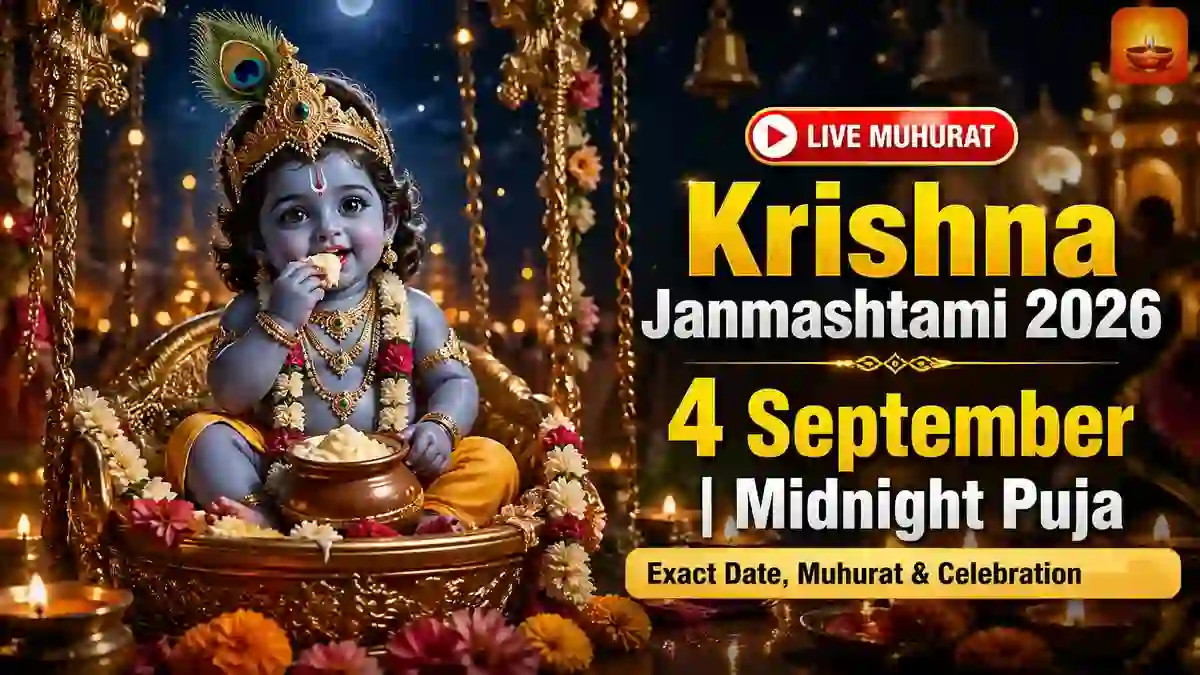
Krishna Janmashtami 2026 will be celebrated on Friday, September 4 tithi. The festival marks the birth of Lord Krishna and is observed with fasting, prayers, devotional singing, Krishna Puja and midnight celebrations.
According to the Panchang, Ashtami Tithi begins at 2:25 AM on September 4 and ends at 12:13 AM on September 5, 2026. The Rohini Nakshatra begins at 12:29 AM on September 4 and ends at 11:04 PM on September 4.
The main Krishna Janmashtami Puja is performed during Nishita Kaal, the Hindu midnight period associated with the birth of Lord Krishna.
Krishna Janmashtami 2026 Date and Time
| Event | Date & Time |
|---|---|
| Krishna Janmashtami | Friday, September 4, 2026 |
| Ashtami Tithi Begins | 2:25 AM, September 4 |
| Ashtami Tithi Ends | 12:13 AM, September 5 |
| Rohini Nakshatra Begins | 12:29 AM, September 4 |
| Rohini Nakshatra Ends | 11:04 PM, September 4 |
| Nishita Puja Time | 11:57 PM to 12:43 AM |
| Midnight Moment | 12:20 AM, September 5 |
| Parana Time | After 6:01 AM, September 5 |
| Dahi Handi | Saturday, September 5, 2026 |
Note: Panchang timings can vary by location. The timings above are based on the New Delhi, India calculation. If you are observing Janmashtami in another city, check the local Panchang for the exact Nishita Kaal and Parana time.
What is Krishna Janmashtami?
Krishna Janmashtami is a major Hindu festival that celebrates the birth of Lord Krishna. According to Hindu tradition, Krishna was born at midnight in Mathura to Devaki and Vasudeva during the reign of King Kansa.
The festival is observed on the Ashtami Tithi of Krishna Paksha in the month of Bhadrapada. Because Hindu festivals are determined by the lunar calendar, the date of Janmashtami changes from year to year.
Janmashtami is also known by several regional names, including Krishnashtami, Gokulashtami, Sree Jayanthi and Ashtami Rohini.
Why is Krishna Janmashtami Celebrated?
Krishna Janmashtami is celebrated to remember the divine birth of Lord Krishna and his role in restoring dharma.
Krishna’s life and teachings are associated with several important spiritual values:
- The victory of good over evil
- Protection of dharma
- Devotion and surrender to God
- Performing one’s duty without attachment
- Compassion and love
- Standing against injustice
For devotees, Janmashtami is not simply a celebration of Krishna’s birth. It is also an opportunity to remember his teachings and bring greater devotion into daily life.
When is Krishna Janmashtami 2026?
Krishna Janmashtami 2026 falls on Friday, September 4.
The Ashtami Tithi begins at 2:25 AM on September 4 and ends at 12:13 AM on September 5. Rohini Nakshatra remains in effect from 12:29 AM until 11:04 PM on September 4.
The midnight period is especially important because Krishna’s birth is traditionally believed to have taken place at midnight.
Is Janmashtami on August 26 or 27 in 2026?
No. Krishna Janmashtami is observed on September 4, 2026, according to the Panchang calculation used here.
The August dates seen in some searches may refer to another year. For example, Krishna Janmashtami falls on August 25 in 2027.
Because Janmashtami follows the Hindu lunar calendar, its Gregorian date changes every year.
Krishna Janmashtami 2026 Puja Muhurat
The most important time for Krishna Janmashtami Puja is Nishita Kaal, the sacred midnight period.
For 2026, the Nishita Puja time is:
11:57 PM to 12:43 AM
The midnight moment falls at approximately 12:20 AM on September 5.
Devotees traditionally perform the main Krishna Puja during this period. The idol of Bal Gopal or Laddu Gopal may be bathed, dressed in new clothes, decorated with flowers and offered bhog.
What is Nishita Kaal?
Nishita Kaal refers to the midnight period in Hindu timekeeping. It is considered particularly important for Krishna Janmashtami because Lord Krishna is traditionally believed to have been born at midnight.
During Nishita Kaal, devotees may perform:
- Krishna Abhishek
- Panchamrit Abhishek
- Krishna Puja
- Aarti
- Offering of bhog
- Chanting of Krishna mantras
- Bhajans and kirtans
- Cradle ceremony for Bal Gopal
The exact Nishita Kaal differs from city to city, so devotees should use their local Panchang when performing the midnight Puja.
Krishna Janmashtami Puja Vidhi at Home
Devotees can observe Janmashtami at home with a simple and devotional Puja.
1. Clean the Puja Area
Clean the home and especially the place where the Krishna idol will be placed. Decorate the Puja area with flowers, lights or a small Krishna jhula.
2. Place the Krishna Idol
Place a Bal Gopal or Laddu Gopal idol on a clean platform or decorated cradle.
You can decorate the idol with new clothes, ornaments, flowers and Tulsi leaves.
3. Take Sankalpa
After completing the morning rituals, devotees who are fasting can take a Sankalpa, or religious vow, to observe the Janmashtami fast.
4. Perform Krishna Abhishek
During the midnight Puja, devotees traditionally bathe the Krishna idol with Panchamrit and then clean water.
Panchamrit is commonly prepared using:
- Milk
- Curd
- Ghee
- Honey
- Sugar
After the Abhishek, the idol is dried and dressed in fresh clothes.
5. Offer Flowers and Tulsi
Offer flowers and Tulsi leaves to Lord Krishna. Tulsi is traditionally considered especially sacred in Krishna worship.
6. Offer Bhog
Common offerings include:
- Makhan-Mishri
- Fruits
- Milk
- Panjiri
- Sweets
- Dry fruits
The exact offerings can vary according to family and regional traditions.
7. Perform Aarti
Perform Krishna Aarti during or after the midnight celebration. Devotees may also sing Krishna bhajans and chant the names of Krishna.
8. Celebrate Krishna’s Birth
Many families place Bal Gopal in a decorated cradle and gently swing the cradle after the midnight Puja as part of the birth celebration.
Krishna Janmashtami Puja Samagri
The following items can be prepared for a simple Janmashtami Puja:
- Krishna or Bal Gopal idol
- New clothes for the idol
- Jhula or cradle
- Flowers
- Tulsi leaves
- Panchamrit ingredients
- Milk
- Curd
- Ghee
- Honey
- Sugar or Mishri
- Fruits
- Makhan
- Sweets
- Incense
- Diya
- Cotton wicks
- Kumkum
- Chandan
- Akshat
- Gangajal or clean water
- Aarti plate
You do not need to arrange every item for a simple home Puja. The most important part of the observance is devotion and sincere worship.
Krishna Janmashtami Vrat Rules
Fasting is an important part of Janmashtami observance. However, fasting practices differ among families and traditions.
Devotees may observe a strict fast or a fruit-and-milk-based fast depending on their health, tradition and personal practice.
What Can Be Eaten During Janmashtami Vrat?
People observing a Phalahar-style fast may traditionally consume foods such as:
- Fruits
- Milk
- Curd
- Coconut
- Nuts
- Makhana
- Sabudana
- Samak rice
- Kuttu preparations
- Singhara flour preparations
- Sweet potato
- Sendha namak
What Should Be Avoided During Janmashtami Fast?
Devotees commonly avoid:
- Regular grains
- Wheat
- Rice
- Pulses
- Non-vegetarian food
- Onion
- Garlic
- Alcohol
Fasting rules can differ between traditions. People with health conditions, children, elderly devotees and pregnant women should follow appropriate dietary advice rather than attempting a strict fast.
When Should the Janmashtami Fast Be Broken?
Breaking the fast is known as Parana.
According to the Panchang calculation given above, the Parana time for 2026 is after 6:01 AM on September 5, subject to the applicable fasting tradition.
For Janmashtami, some traditions give importance to the completion of Ashtami Tithi and Rohini Nakshatra before breaking the fast. Other devotees follow the practice of breaking the fast after Nishita Kaal or according to their family tradition.
Therefore, the correct Parana rule can differ depending on the tradition being followed.
Smarta and Vaishnava Janmashtami
One reason people sometimes see different Janmashtami dates is that different Hindu traditions use different rules for determining the festival day.
Smarta and Vaishnava traditions can differ in the way they determine the Janmashtami observance, particularly when Ashtami Tithi and Rohini Nakshatra overlap across two calendar dates.
ISKCON follows the Vaishnava tradition.
For this reason, devotees should follow the Panchang and religious tradition used by their family, temple or sampradaya rather than assuming that every community must observe the festival in exactly the same way.
Krishna Janmashtami in Mathura and Vrindavan
Mathura and Vrindavan hold a special place in Krishna tradition.
Mathura is traditionally regarded as the birthplace of Krishna, while Gokul and Vrindavan are closely associated with his childhood pastimes.
During Janmashtami, temples and homes are decorated with flowers and lights. Devotees participate in bhajans, kirtans, Jhankis, Krishna Puja and midnight celebrations.
Janmashtami in Mathura
Mathura’s Krishna Janmabhoomi is one of the major pilgrimage destinations associated with Janmashtami. Devotees gather for special prayers and the midnight birth celebration.
Janmashtami in Vrindavan
Vrindavan celebrates Janmashtami with temple decorations, devotional singing, special Darshan and Krishna-related cultural programs.
Janmashtami in Gokul
Gokul is associated with Krishna’s childhood and the home of Nanda and Yashoda in Hindu tradition. The day following Janmashtami is associated with Nandotsav, celebrating Nanda’s joy after Krishna’s birth.
Krishna Janmashtami and Dahi Handi
Dahi Handi is associated with Krishna’s childhood stories of stealing butter and curd.
On Dahi Handi, groups form human pyramids to reach and break a clay pot filled with curd or other items. The tradition is particularly popular in Maharashtra and several other parts of India.
In 2026, Dahi Handi is observed on Saturday, September 5.
Krishna Janmashtami Story
According to Hindu tradition, Krishna was born to Devaki and Vasudeva in Mathura.
King Kansa, the ruler of Mathura and Devaki’s brother, had learned of a prophecy that Devaki’s eighth son would be responsible for his downfall. Because of this fear, Devaki and Vasudeva were imprisoned.
When Krishna was born at midnight, Vasudeva carried the newborn Krishna from Mathura to Gokul. Krishna was then raised in the household of Nanda and Yashoda.
Krishna’s childhood stories became an important part of Hindu devotional traditions. His playful childhood, love of butter, friendship with the Gopas and Gopis, and later role in the Mahabharata and Bhagavad Gita have made him one of the most widely worshipped figures in Hinduism.
Why is Krishna Worshipped at Midnight?
Midnight has special significance on Janmashtami because Krishna’s birth is traditionally believed to have occurred at midnight.
Devotees therefore remain awake, sing bhajans, chant Krishna’s name and prepare for the midnight Puja.
At the moment of Krishna’s birth celebration, temples and homes may ring bells, blow conches and perform Aarti.
Krishna Janmashtami Mantra
One commonly recited Krishna mantra is:
Om Namo Bhagavate Vasudevaya
Devotees may also chant:
Hare Krishna Hare Krishna, Krishna Krishna Hare Hare
Hare Rama Hare Rama, Rama Rama Hare Hare
The mantra can be recited during the day, during the fast or as part of the midnight celebration.
How to Celebrate Janmashtami at Home
A simple home celebration can include:
- Clean and decorate the Puja area.
- Place Bal Gopal or Krishna’s idol in a decorated Jhula.
- Observe a fast according to your tradition.
- Read or listen to Krishna’s birth story.
- Chant Krishna mantras and sing bhajans.
- Prepare Panchamrit and bhog.
- Perform Krishna Abhishek around Nishita Kaal.
- Dress and decorate the Krishna idol.
- Perform Aarti at midnight.
- Distribute Prasad among family members.
What is the Significance of Janmashtami?
Janmashtami reminds devotees of Krishna’s teachings about dharma, duty, devotion and spiritual wisdom.
Krishna’s teachings in the Bhagavad Gita emphasize performing one’s duty without attachment to the results and maintaining faith during difficult circumstances.
For devotees, celebrating Krishna’s birth is therefore both a religious observance and an opportunity for spiritual reflection.
Krishna Janmashtami 2027
If you are planning ahead, Krishna Janmashtami 2027 will be observed on Wednesday, August 25, 2027, according to the Panchang calculation referenced here.
The exact Puja and fasting timings for 2027 should be checked separately because Tithi, Nakshatra and Nishita Kaal timings change each year.
For more helpful content and updates, follow us on Instagram and Quora.
About:
This article is prepared by the Shrimahalaxmi Calendar editorial team using traditional Panchang references and festival calculations.
FAQ
Krishna Janmashtami is on 4 September 2026 (Friday).
Midnight puja time is 11:26 PM to 12:11 AM.
No, in 2026 it is on 4 September.
Yashoda and Nanda adopted Krishna.
It is the story of Krishna’s birth in Mathura and his escape from Kansa.

1 thought on “Krishna Janmashtami 2026: Date, Time, Puja Muhurat, Vrat and Significance”